
Role of Social Media in Religious Values and Islamic Banks Financial Performance
DOI:
https://doi.org/10.62019/abcief.v5i1.53Keywords:
Social media, religious values, trust, bank personnel’s professionalism, financial performance.Abstract
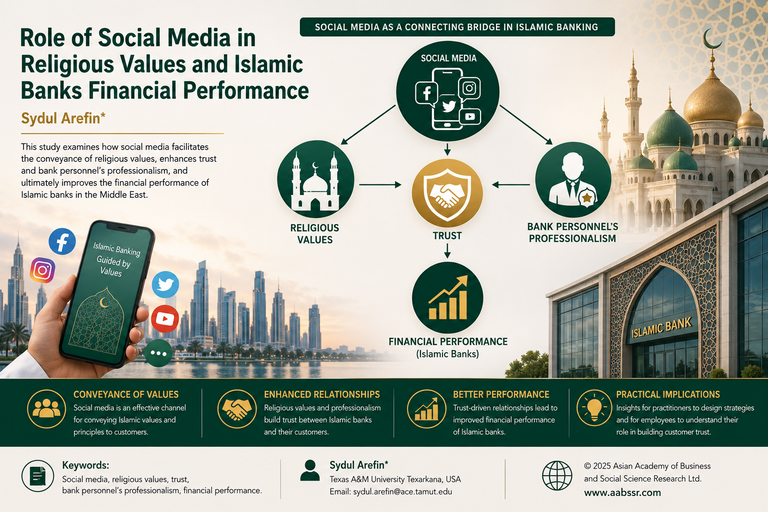
The purpose of this study is to examine the role of social media in financial performance of Islamic banks in Middle East.This study adopted quantitative research approach and survey questionnaire was used for data collection by using a cross-sectional research design. Data were analyzed by using Partial Least Square-Structural Equation Modeling (PLS-SEM). It was concluded that social media play a positive role in the conveyance particularly about religious values, between the Islamic banking system and its customers that eventually add values to build customers’ trust rate and bank personnel’s professionalism which guarantees an increase in the financial performance of Islamic banking system.
Originality: This study examined the unique relationship between social media, religious values, personnel’s professionalism, trust and financial performance in Middle East Islamic banking sector which is not considered in previous studies. This is pioneer study which examined the effect of social media on bank personnel’s professionalism, religious values and trust in Islamic banks along with the indirect effect of religious values.This study helps practitioners to boost the financial performance of Islamic banking system. Moreover, this study, also helps employees to understand professionalism related duties specifically which influences the employees and the bank customer’s relationship. Therefore, this study is helpful for practitioners while making the strategies to promote financial performance of Islamic banks.
Downloads
Published
How to Cite
Issue
Section
License
Copyright (c) 2025 The Asian Bulletin of Contemporary Issues in Economics and Finance (ABCIEF)

This work is licensed under a Creative Commons Attribution-NonCommercial-NoDerivatives 4.0 International License.
Copyright and Licensing
Authors shall retain the copyrights to the article. Author(s) grant ABCIEF an irrevocable, non-exclusive license to publish the article electronically and in print format, and to identify itself as the original publisher. Author(s) can grant any third party the right to use the article freely as long as its original authors and citation details are identified. The article is distributed under the Creative Commons Attribution 4.0 License. Unless otherwise stated, associated published material shall be distributed under the same license.
You are free to:
- Share —copy and redistribute the material in any medium or format
- Adapt —remix, transform, and build upon the material for any purpose, even commercially.
Under the following conditions:
- Attribution —You must give appropriate credit, provide a link to the license, and clearly indicate if any changes were made. You may do so in any reasonable manner, but not in any way that suggests the licenser endorses you or your use.
- No additional restrictions — You may not apply legal terms or technological measures that legally restrict others from doing anything the license permits.


