
Mineral Resources, Fintech, Innovative Human Capital, and CO2 Emissions: Missing Evidence from The Mineral Rich Asian Countries
DOI:
https://doi.org/10.62019/abcief.v5i1.55Keywords:
Innovative human capital, Mineral resources, financial technology, CO2 emissions, Sustainable developmentAbstract
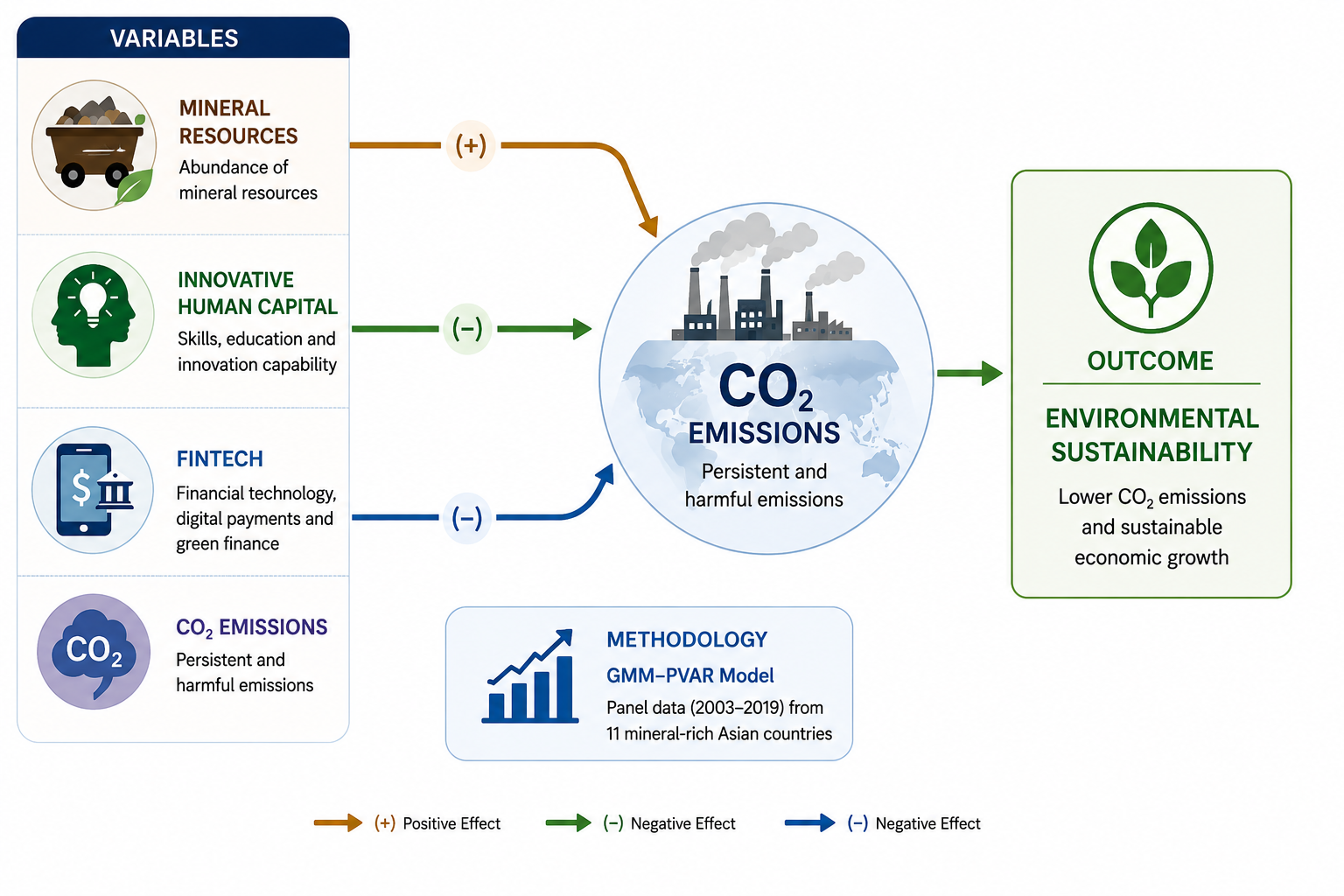
This paper examines the intricate relationship between innovative human capital, mineral resources, fintech, and CO2 emissions across mineral-rich Asian countries, highlighting the pressing need for sustainable development. Through a comprehensive literature review and empirical analysis using the Generalized Method of Moments-Panel Vector Autoregression (GMM-PVAR) model, the study underscores the persistent nature of CO2 emissions and the critical role of human capital and fintech in mitigating environmental degradation. It reveals a positive correlation between the abundance of mineral resources and CO2 emissions, suggesting a dire need for sustainable resource management. Moreover, the study demonstrates the significant negative impact of fintech on CO2 emissions, offering new pathways for green finance and sustainable economic practices. By analysing data from 2003 to 2019 across selected countries, this paper contributes to the understanding of how innovative human capital and technological advancements in finance can lead to a reduction in CO2 emissions. It concludes with policy implications that advocate for the integration of sustainability into economic planning, the promotion of green skills and education, and the harnessing of fintech for environmental sustainability. This study not only provides valuable insights for policymakers in Belt and Road Initiative countries but also lays the groundwork for a more sustainable and environmentally conscious global economy.
Downloads
Published
How to Cite
Issue
Section
License
Copyright (c) 2025 The Asian Bulletin of Contemporary Issues in Economics and Finance (ABCIEF)

This work is licensed under a Creative Commons Attribution-NonCommercial-NoDerivatives 4.0 International License.
Copyright and Licensing
Authors shall retain the copyrights to the article. Author(s) grant ABCIEF an irrevocable, non-exclusive license to publish the article electronically and in print format, and to identify itself as the original publisher. Author(s) can grant any third party the right to use the article freely as long as its original authors and citation details are identified. The article is distributed under the Creative Commons Attribution 4.0 License. Unless otherwise stated, associated published material shall be distributed under the same license.
You are free to:
- Share —copy and redistribute the material in any medium or format
- Adapt —remix, transform, and build upon the material for any purpose, even commercially.
Under the following conditions:
- Attribution —You must give appropriate credit, provide a link to the license, and clearly indicate if any changes were made. You may do so in any reasonable manner, but not in any way that suggests the licenser endorses you or your use.
- No additional restrictions — You may not apply legal terms or technological measures that legally restrict others from doing anything the license permits.


